
What is universal design for learning? A Practical Guide to Inclusive Training

Universal Design for Learning (UDL) isn't just another educational buzzword. It’s a complete shift in how we think about teaching and learning. At its heart, UDL is about creating flexible learning experiences from the get-go, whether you’re in a classroom or a corporate training session. It’s about building in options for how people take in information and show you what they know.
The big idea? We accept that everyone learns differently—and that’s the norm, not something to be fixed later.
What Is Universal Design for Learning, Really?
Think about it like this: when an architect designs a building with ramps and automatic doors, they aren’t just thinking about wheelchair users. Those features also help a parent with a pram, a delivery person with a trolley, or someone hobbling on crutches. That’s the core of Universal Design for Learning. It’s not about adding fixes for a few people after the fact; it’s about proactively designing a learning environment that simply works better for everyone.
This proactive mindset makes the entire experience more inclusive and effective right from the start. Instead of forcing everyone down a single, rigid path, UDL provides multiple, flexible routes to the same goal. For example, instead of only offering a textbook, a UDL approach would also provide an audiobook version and a summary video right from day one.
Moving Beyond a One-Size-Fits-All Model
The old-school approach to education often gave us just one way to learn: read this textbook, sit through that lecture, write an essay. That method works fine for some, but for many others, it throws up unnecessary barriers. UDL completely dismantles this one-size-fits-all model by recognising that every single person brings a unique mix of strengths, needs, and interests to the table.
This philosophy really started to gain ground in UK higher education in the 2010s. De Montfort University, for example, was a trailblazer. They didn't see UDL as a remedial tool for disabled students, but as a brilliant framework for embedding flexibility into all their teaching. It made education more adaptable and effective for everyone.
Universal Design for Learning is not just about helping learners with disabilities. It’s about creating an educational ecosystem where every single learner has the opportunity to thrive by providing them with the tools and choices they need to succeed.
To help you visualise this shift, here’s a quick comparison of the old way versus the UDL way.
UDL Quick-Start: The Shift from Traditional to Inclusive Design
This table shows how UDL flips the script from a reactive, one-size-fits-all approach to a proactive, flexible framework designed for everyone.
Characteristic | Traditional Approach (Reactive) | UDL Approach (Proactive) |
|---|---|---|
Curriculum Design | A single, fixed path for all learners. | Multiple, flexible pathways to learning goals. |
Learner Variability | Seen as a problem to be solved with accommodations. | Recognised and valued as the norm. |
Materials & Media | Primarily text-based (e.g., textbooks, lectures). | A mix of media: text, video, audio, interactive tools. |
Assessment | One or two standardised methods (e.g., essays, exams). | Multiple options to demonstrate knowledge (e.g., video, presentation, project). |
Focus | On the content and what is being taught. | On the learner and how they are learning. |
Accessibility | Added on as an afterthought or special request. | Built-in from the very beginning of the design process. |
Seeing them side-by-side really highlights how UDL is fundamentally about smart, inclusive design, not just after-the-fact adjustments.
The Goal Is Expert Learners
Ultimately, the whole point of UDL is to cultivate "expert learners". These are people who are resourceful, knowledgeable, strategic, and fired up about learning. An expert learner knows how they learn best. For example, they might realize they understand concepts better after watching a video, so they actively seek out video resources before starting a reading assignment.
We get there by intentionally designing our curriculum to address the three core networks of the brain involved in learning. These principles give us a clear blueprint for offering:
Multiple ways for learners to get engaged with the material.
Various methods for presenting information and content.
Different options for learners to express what they now understand.
By building in this kind of flexibility, we knock down obstacles and empower people to take real ownership of their learning journey. You can dig deeper into the crucial role of accessibility in creating these supportive environments.
The Three Core Principles of UDL
To really get what Universal Design for Learning is all about, you have to look under the bonnet at its engine: three core principles grounded in how our brains actually learn. Think of them less as abstract theories and more as a practical blueprint for designing learning that’s flexible enough for everyone. They are the toolkit every educator or trainer needs to reach every single learner.
The UDL framework is built around providing:
Multiple Means of Engagement (the ‘Why’ of learning)
Multiple Means of Representation (the ‘What’ of learning)
Multiple Means of Action & Expression (the ‘How’ of learning)
Let’s break down what each of these means with some real-world examples you can start using right away.
Multiple Means of Engagement: The 'Why' of Learning
Engagement is the emotional heart of learning. It’s about sparking that initial curiosity and then feeding it enough to keep the motivation going. When learners aren't engaged, even the most brilliantly designed content can fall completely flat. The goal here is to offer choices that tap into what individuals find interesting and motivating, making the whole experience feel relevant and purposeful.
An actionable insight here is to connect learning to real-world outcomes. Instead of just teaching the theory of project management, you could start a module by saying, "This week, you'll learn a technique that will help you run meetings that actually finish on time." This immediately makes the 'why' clear and relevant.
Another powerful tactic? Foster a bit of teamwork. For example, you can set up a short, 15-minute "think-pair-share" activity where learners discuss a concept with a partner before sharing with the larger group. This gets them talking, sharing ideas, and building a sense of community, making the process more dynamic and less isolating.
By offering varied ways to engage, we create a learning environment that feels less like a requirement and more like an opportunity. This shift is crucial for developing self-motivated, lifelong learners.
The diagram below shows just how different the UDL approach is, creating flexible paths to learning in stark contrast to more rigid, traditional methods.
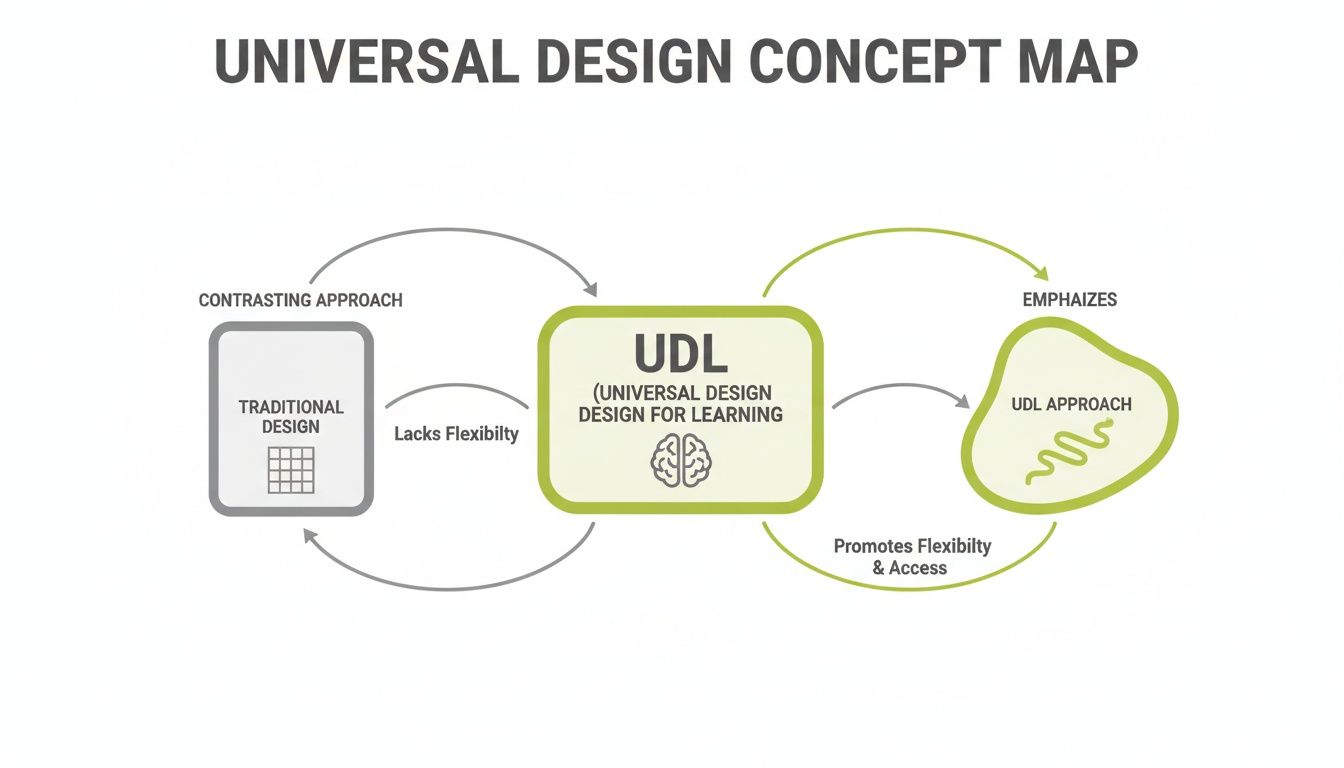
This visual really brings it home: while traditional design forces everyone down one single path, UDL provides multiple routes to the same destination, honouring the fact that everyone is different.
Multiple Means of Representation: The 'What' of Learning
This principle gets straight to the point: people take in and understand information in wildly different ways. A wall of text might be perfect for one person, but for another, it's a huge barrier. Providing the same information in multiple formats ensures everyone can access and make sense of the core concepts.
Think beyond the standard textbook or slide deck for a moment. A practical example would be teaching a new software process. You could provide:
A step-by-step written guide with screenshots for those who like to read and follow along.
A short screen-recorded video (with captions) demonstrating the process for visual learners.
An interactive simulation where learners can click through the process in a safe, controlled environment.
This multi-modal approach doesn’t just cater to different preferences; it deepens understanding for everyone by showing the content through various lenses. A simple, actionable takeaway is to ask yourself: "What is one other way I could present this key idea?" Even adding an audio summary to a dense document is a great start.
Multiple Means of Action and Expression: The 'How' of Learning
Finally, UDL acknowledges that a single assessment method—like a timed exam or a formal essay—doesn't give an accurate picture of what every student actually knows. This principle is all about giving learners flexible options to show their mastery and express what they’ve learned.
It’s about separating the goal of the learning from the method used to show it. If the goal is to assess a learner's ability to analyse a character in a novel, must it be through a 1,000-word essay? A practical alternative could be to ask them to create a detailed mind map or record a 5-minute podcast episode dissecting the character's motivations.
Here are a few practical alternatives to the old-school assessment:
Create a short video or podcast explaining a key concept.
Build a website or an interactive presentation to showcase their research.
Develop a physical model or a hands-on demonstration.
Write a traditional paper or take a digital quiz.
By offering these choices, you empower learners to play to their strengths. Someone who’s a natural public speaker can create a compelling presentation, while a gifted writer can craft a beautifully detailed essay. This flexibility doesn't just give you a more accurate read on their knowledge—it also dials down the anxiety that often comes with high-stakes, one-size-fits-all assessments.
Putting UDL into Practice with Your LMS
Knowing the theory behind Universal Design for Learning is one thing, but making it happen in your courses is where the real magic lies. Theory doesn't build an inclusive classroom; action does. The great news is you probably already have the tools you need to get started, especially your Learning Management System (LMS) and a good video platform.
Your LMS is the central hub for all your learning content, which makes it the perfect place to start weaving in UDL principles. An actionable first step is to review one of your existing courses and identify a single lesson where you can add one new resource—like a short video or an audio summary—to give learners more choice.
Enhancing Representation with Video and AI
The first principle, Multiple Means of Representation, is all about giving learners different ways to take in information. Video is an obvious powerhouse here, but just dumping a lecture recording into your LMS won't cut it. To do UDL right, that video needs to be accessible and adaptable for everyone.
For a practical example, consider a pre-recorded lecture. Using a video platform like MEDIAL within your LMS, you can automatically generate accurate captions with AI. This is a game-changer for learners who are deaf or hard of hearing, but it also helps someone watching in a loud café or a non-native English speaker who benefits from seeing the words on screen.
You can take it another step further by offering a downloadable transcript. This simple move serves a bunch of different needs at once:
Learners who prefer to read can go through the material at their own speed.
Students can quickly search the text for keywords when they're studying for an exam.
The content is instantly usable by screen readers, opening it up for visually impaired learners.
This isn't just about ticking an accessibility box. It's about providing robust, flexible options so learners can connect with the material in the way that makes the most sense for them.
This flexibility is more important than ever. Across UK higher education, learner variability is a huge challenge, and a one-size-fits-all approach just doesn't work anymore. By 2019-20, around 70% of students were from the 'iGeneration' (born after 1995), a group that primarily gets online via their phones. This shift means we have to offer content in multiple ways, moving well beyond old-school, computer-based teaching.
Offering Flexible Action and Expression
How learners show what they know is just as crucial as how they learn it. The principle of Multiple Means of Action and Expression is about giving them choices in how they're assessed. And your LMS is the perfect place to manage all those different submission types.
Instead of insisting on a written essay from everyone, why not let learners submit a video presentation? With a tool like MEDIAL’s webcam recorder built right into the LMS, a student can record, review, and submit their assignment without ever leaving the course page. This is fantastic for students who are better at explaining things out loud than they are at writing, allowing them to truly demonstrate their understanding.
By decoupling the assessment format from the learning objective, you get a more authentic measure of a student's knowledge. The goal is to assess their understanding of the topic, not their ability to write a formal paper.
To really put this into practice, you need to know your LMS inside and out. It helps to explore strategies for Mastering Enterprise Learning Management Systems so you can set up and present these assessment options clearly. A well-organised LMS makes offering multiple pathways feel totally seamless for both you and your students. For a refresher, check out our guide on what is a learning management system.
Boosting Engagement Through Interaction
The final piece of the UDL puzzle is Multiple Means of Engagement—the ‘Why’ of learning. Technology gives us some brilliant ways to make learning more active and collaborative, getting students involved instead of just passively watching.
Interactive video is a superb tool for this. Instead of simply watching a video, learners can actually participate in it. A practical action you can take is to embed a short, two-question quiz halfway through a 10-minute instructional video. This breaks up the content and prompts learners to check their own understanding before moving on.
You can set up questions to pop up at just the right moment, reinforcing a critical concept before the video continues. That immediate feedback helps learners stay plugged in and actively process the information.
Live-streamed events are another powerful way to boost engagement. You could host a live Q&A session right through your platform, giving learners a chance to ask questions in the moment. It builds a sense of community and makes the instructor feel more approachable, turning a one-way lecture into a genuine two-way conversation. This is especially vital in remote or hybrid courses where building those personal connections can be a real challenge.
Applying UDL Principles with MEDIAL in Your LMS
Bringing these ideas to life is easier when you have the right tools. The table below shows how specific MEDIAL features, integrated within your LMS, directly support the three core principles of UDL.
UDL Principle | Practical Application Using MEDIAL | Benefit for the Learner |
|---|---|---|
Multiple Means of Representation | Use AI to auto-generate captions and searchable transcripts for all video content. | Provides text-based alternatives for auditory content, supporting accessibility and different learning preferences. |
Multiple Means of Action & Expression | Enable the webcam/screen recorder assignment type for submissions. | Allows learners to submit video presentations or screencasts instead of traditional essays, playing to their strengths. |
Multiple Means of Engagement | Embed interactive quizzes and polls directly into instructional videos. | Turns passive viewing into active participation, providing immediate feedback and reinforcing key concepts. |
By using a platform like MEDIAL, you’re not just adding features; you're building a more flexible and supportive learning environment that empowers every student to succeed.
UDL in Action: Real-World Scenarios
Theory is great, but seeing Universal Design for Learning in the wild is what really makes it click. UDL isn't some abstract ideal; it’s all about the concrete choices we make as educators and trainers to make learning stick for everyone. Let’s bring this framework to life with two relatable scenarios, one from a university and another from a corporate training department.
These stories show just how simple shifts in design can open up powerful and inclusive learning opportunities.
Scenario One: The University History Module
Dr. Evans is redesigning her final-year history module on the Industrial Revolution. For years, the final assessment was a single 3,000-word research paper. It worked for some, but she noticed many students struggled to really show what they knew through that one rigid format. This year, she’s decided to inject some UDL principles to give her students more control.
Instead of one path, she now offers three ways to demonstrate their understanding:
Write the traditional research paper: This is still an option for students who shine with written analysis and structured arguments.
Create a short documentary film: Perfect for the visual storytellers in the group, allowing them to use archival footage, interviews, and narration to build their case.
Build an interactive website: This appeals to learners skilled in digital design who want to present their research using timelines, maps, and other multimedia elements.
The learning goal—analysing the impact of the Industrial Revolution—is exactly the same. The difference is that now, the path to proving mastery is flexible.
By providing these choices, Dr. Evans isn't lowering her standards; she's removing unnecessary barriers. The focus shifts from a student’s ability to write a long-form essay to their ability to research, synthesise, and present complex historical information effectively.
This approach hits all three UDL principles perfectly:
Engagement: Students are way more invested because they can pick a project that plays to their strengths and interests. Motivation gets a serious boost.
Representation: Throughout the module, Dr. Evans provides resources in multiple formats—academic journals, video lectures with captions, and primary source documents—to support every project type.
Action & Expression: The assessment itself is a masterclass in this principle, offering multiple, equally valid ways for students to show what they know.
Scenario Two: Corporate Compliance Training
Over at a big tech firm, Liam is in charge of redesigning the mandatory annual compliance training. The old version was a monster 80-page PDF followed by a quiz. The feedback was always terrible; employees called it boring, hard to remember, and totally disconnected from their actual jobs. Liam decides to overhaul it with a UDL approach to make it more effective and, frankly, less of a chore.
He restructures the whole thing to offer different ways to get through the material. Employees can now choose their preferred learning path:
Read the official documentation: The original PDF is still there for those who prefer to dive into the details with a text-based reference.
Watch short animated videos: A series of five-minute animated videos breaks down key policies into bite-sized, visually engaging scenarios.
Listen to a podcast: An interview with the company’s compliance officer gives a conversational, real-world perspective on why these rules actually matter.
Everyone still has to pass the final assessment, but now they can prepare for it in a way that works best for them. He’s acknowledging that a software engineer and a sales executive might absorb information very differently.
A key part of putting UDL into practice is understanding how SEL supports neurodiverse students, which helps create learning environments that truly work for a wide range of needs.
Here's how Liam’s redesign reflects the UDL principles:
Engagement: Using a podcast and animated videos makes the content feel more relevant and way less intimidating, which helps people actually pay attention.
Representation: The same core compliance information is presented through text, video, and audio. This ensures every employee can access and understand it.
Action & Expression: While the final quiz is standard, Liam adds optional, low-stakes knowledge checks after each video or podcast episode so employees can check their own understanding as they go.
In both of these real-world examples, the educators didn't triple their workload. Instead, they thoughtfully designed flexible pathways to the same clear learning goal. That, right there, is the heart of what Universal Design for Learning is all about—proactive, inclusive design that helps every single learner succeed.
How to Build a UDL Culture
Getting Universal Design for Learning right isn't just about grabbing a few new tools or tweaking a couple of lesson plans. It’s a fundamental shift in mindset that has to work its way through your entire organisation. Moving from a solo effort to a team sport takes a real strategy for getting colleagues and leadership on board.
This cultural shift starts when inclusive design becomes the way things are done, not a special project on the side. A practical first step is to add a "UDL check" to your course design template. This could be a simple question like, "How have we offered choice in this module?" Making it part of the process is key.
Championing UDL in Your Institution
You don’t have to change everything overnight to become a catalyst for change. It all starts with small, smart actions. A simple roadmap can help you build momentum and show the value of UDL to even the most doubtful colleagues, transforming you from a lone voice into a leader for change.
Here’s a practical, three-step approach to get the ball rolling:
Start with a Pilot Project: Pick one course or training module to redesign using UDL principles. For example, choose a high-enrolment course that consistently gets poor feedback and apply UDL to just one of its four modules.
Share Success Stories with Data: After the pilot, gather feedback. Did learners who chose the video assignment score as well as those who wrote the essay? Did engagement rates on the discussion board increase? Present this specific, tangible data to leadership.
Build a Coalition: Find other people who get it. A practical action is to start a small "lunch and learn" series where you share what you've learned. Invite colleagues from different departments to create a cross-functional team of advocates.
Measuring What Truly Matters
To make a strong case for UDL, you need to look beyond test scores. While grades have their place, a true UDL culture looks at a much bigger picture of success. The focus shifts to metrics that give you a more complete story of the learning experience.
Shifting your measurement strategy is key. When you start tracking engagement and satisfaction, you're not just measuring learning outcomes; you're measuring the health of your learning culture. This data provides the evidence needed to justify continued investment in UDL.
In a university setting, this might mean tracking how many students use optional resources or hand in assignments in different formats. In corporate training, a practical metric could be tracking the completion rate of an optional "deeper dive" video after the mandatory content is finished—a clear sign of genuine engagement.
This kind of coordinated, evidence-based approach has been critical for scaling UDL across the UK. Professional networks like UDL UK and Ireland (UDL-UKI) were set up specifically to support and promote effective UDL in higher education. This collaborative spirit really shows the power of sharing best practices and data. You can read the full research about these UDL initiatives here.
Your UDL Implementation Checklist
Right, so you're ready to get started. Shifting to Universal Design for Learning isn’t about throwing out everything you've built and starting from scratch overnight. It’s about making small, intentional tweaks that open up learning for everyone.
Think of this checklist as a practical guide for reflection. Before you put together your next lesson or training module, run through these simple, action-focused questions. They'll help you spot easy wins for adding more flexibility and choice.
Engagement: The 'Why' of Learning
To get learners hooked and keep them motivated, ask yourself:
Could I let learners pick the topic for their next assignment? Making it relevant to their own interests is a huge motivator.
Is there a quick way to build in some collaboration, like a short peer-review activity or a group problem-solving task?
Can I tie the learning goal to a real-world problem or a scenario that learners will actually care about?
Representation: The 'What' of Learning
To make sure everyone can actually access and understand the content, have a think about these options:
For my next lesson, can I offer just one alternative to pure text? Maybe a short audio summary or a relevant video with captions?
Are my digital materials flexible? For instance, can learners easily adjust the font size or use a text-to-speech tool on the document?
Could I use a simple visual aid, like a diagram or a graphic organiser, to help clarify a tricky concept?
A powerful first step towards better representation is making sure all your video content is fully accessible. You can learn more about the massive benefits of unlocking accessibility with AI auto-captioning to make your materials work for every single learner.
Action and Expression: The 'How' of Learning
To give learners different ways to show you what they've learned, consider this:
On the next assignment, can I offer one alternative way for learners to demonstrate their knowledge? Maybe a short video presentation instead of a traditional written report?
Could I provide some simple sentence starters or a checklist? This can be a huge help for learners who struggle to organise their thoughts.
Is there a spot for a quick, low-stakes quiz or a self-check? This lets learners gauge their own understanding as they go.
Just by asking one or two of these questions each time you create something new, you’ll start building a more inclusive and effective learning environment—without feeling like you have to do it all at once.
Got Questions About UDL?
As Universal Design for Learning starts to pop up in more conversations, it's natural for a few questions—and a few myths—to follow. Let's clear the air so you can get a real sense of what UDL is all about as you begin weaving its principles into your own work.
Is UDL Just a Fancier Term for Good Teaching?
It's a fair question, and one we hear all the time. The short answer? UDL is more than just good teaching; it's intentionally good teaching. Many fantastic educators already use some of these strategies instinctively. For example, a great teacher might naturally use a diagram to explain a complex idea. The difference is that UDL provides a structured framework to ensure these choices are made purposefully and consistently for every learner.
It’s all about being proactive. Instead of waiting for a learner to hit a wall and then trying to fix it, UDL encourages you to anticipate that people learn differently from the get-go. You build flexible pathways to success right into the design.
Does UDL Mean I Have to Create Three Versions of Everything?
Definitely not. This is probably the biggest misconception out there and a huge source of stress for anyone new to the concept. UDL is about smart, flexible design, not tripling your workload.
The idea isn't to make separate lesson plans for different learners. It's about building that flexibility into one solid plan. For instance, rather than creating a text-only document, a separate video, and an audio file, you could offer one rich resource. Think of a single video that comes with accurate captions and a searchable transcript. That one asset efficiently meets a variety of needs.
UDL focuses on providing flexible options within a single learning experience, not creating completely separate versions. It’s about working smarter, not harder, to remove barriers from the outset.
How Is UDL Different from Accessibility?
Let’s use a home-building analogy. Accessibility is the non-negotiable foundation—it’s about making sure the building meets code so everyone can get through the door. In learning, this means providing captions so a deaf student can access a video. It's a requirement to remove a specific barrier.
UDL, on the other hand, is the architectural blueprint for the entire house. It considers the experience of everyone. In our video example, UDL means providing captions (accessibility), but also a transcript for those who prefer to read, and chapter markers for everyone to easily navigate to key sections. Accessibility gets people in; UDL makes sure the experience is great for all.
Ready to put UDL into action with a platform designed for flexible, accessible learning? Explore how MEDIAL can help you integrate powerful video tools directly into your LMS. Visit us to schedule a demo.
Comments