
Evaluation and Assessment That Works: A Practical Guide

At 9pm on a Tuesday, Priya is staring at 142 ungraded submissions while her laptop fan works harder than she is. Across the organisation, Marcus, a learning and development manager, is fielding Slack messages from sales trainees asking for “just the answer”. Both are facing the same problem: assessment has become a one-way transaction. Learners submit work, educators assign a judgement, and everyone moves on before the evidence can improve the next attempt.
That model creates familiar costs. Feedback arrives late, marking varies between assessors, students learn to game the rubric, and trust gradually weakens. A grade may close a task, but it doesn't necessarily help anyone decide what to practise next.
Evaluation and assessment work better as a feedback loop. A learner produces evidence, an educator interprets it, both identify the next action, and the programme uses the resulting information to improve its design. For Priya and Marcus, that means combining formative checkpoints, transparent rubrics, meaningful summative judgements, and video workflows that move cleanly through the learning management system.
The Pressure Cooker Moment Every Educator Recognises

Priya opens the first submission. The task asks students to explain a complex theory and apply it to practice, but the rubric uses broad phrases such as “excellent understanding” and “strong critical thinking”. She knows what good work looks like, yet she can't point to the exact evidence that separates one level from another. By the time she reaches the final scripts, her interpretation has shifted slightly, even though the rubric hasn't.
Marcus has a different version of the same evening. His trainees have completed a product demonstration, but most questions focus on the scoring rules rather than the customer conversation the task was meant to develop. They want to know which words earn marks. Marcus wants them to notice whether they diagnosed the customer's need, selected relevant evidence, and adapted their recommendation.
The difficulty isn't workload. It's a design problem.
When a grade becomes the end of learning
A summative mark can be useful for progression, certification, and accountability. It becomes less useful when nobody uses the evidence to improve teaching, the assessment itself, or the learner's next performance. A programme that collects grades without examining what produced them is measuring outcomes without completing the learning cycle.
The UK's education system shows how assessment data can become part of public governance. The UK assessment history and accountability analysis describes how school-level examination statistics sit at the heart of England's accountability system across key stage 2, key stage 4, and key stage 5. These statistics also feed performance tables used to compare schools and inform policy.
That history matters because it explains why educators feel pressure to produce defensible numbers. Assessment isn't only a classroom activity. It can influence institutional decisions, public comparisons, and learner opportunities.
Practical rule: Treat every grade as a question, not a conclusion. What did the learner demonstrate, what remains uncertain, and what should change next?
A calmer operating model
Priya could insert a short concept check before the final submission, then use a draft video for targeted feedback. Marcus could ask trainees to submit a brief role-play, annotate the moment where the customer's need was identified, and repeat the task after coaching. Both would gain richer evidence before the high-stakes decision.
The rest of the process depends on making those checkpoints purposeful. Formative work should reveal learning while there's still time to act. Summative work should judge achievement against criteria that learners and markers can interpret consistently. A connected video workflow can preserve the evidence, comments, and decisions inside the LMS rather than scattering them across files, email, and chat.
Formative and Summative Evaluation and Assessment Explained
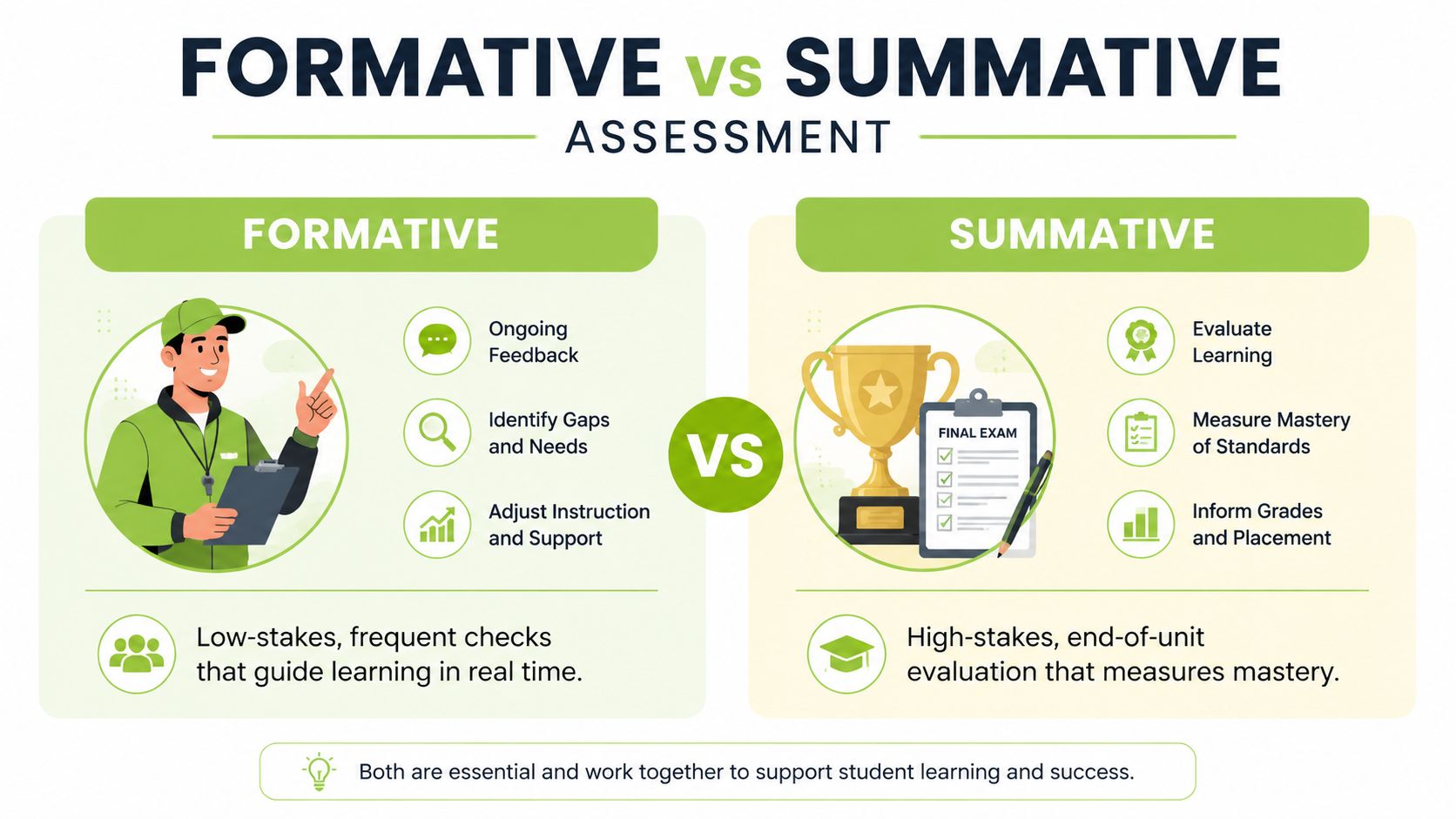
Think of formative assessment as a coach on the sideline. The coach watches the match, spots a problem, and gives advice while the players can still adjust. Formative evaluation performs a similar function for a course or training programme. It asks, “Where are learners now, and what intervention could help them move forward?”
A two-minute concept check at the start of a lecture might reveal that students are confusing correlation with causation. An annotated video draft midway through a module might show that a trainee can describe a procedure but can't yet justify a decision. A peer critique forum can expose gaps before the final submission.
Summative assessment is the judge at the end. It makes a periodic judgement about whether the learner has met the required standard. A graded capstone presentation, a final research project, or an end-of-programme certification exam can support progression and accountability.
The distinction isn't about whether one approach is “good” and the other is “bad”. It concerns timing, purpose, stakes, and how much opportunity the learner has to respond.
Use both modes deliberately
A strong programme uses formative evidence to improve performance before summative evaluation confirms achievement. The formative stage might involve practice questions, a low-stakes recording, or tutor comments. The summative stage then tests whether the learner can perform independently under the defined conditions.
For younger learners, educators looking for practical ideas can use grade 7-12 formative assessment ideas to build short, actionable checks into lessons. In adult education and workplace learning, the same principle applies, although the evidence may come from a simulated client call, a screen recording, or a reflective explanation.
The connection with adult learning is especially important. Adults need to understand why a task matters, connect it with prior experience, and receive feedback they can use. The adult learning principles resource offers a useful lens for designing activities that respect those conditions.
Reliability grows from evidence
A final judgement is stronger when it doesn't appear from nowhere. Formative work helps learners interpret the criteria, gives markers opportunities to identify ambiguity, and reveals whether the task is eliciting the intended skill. It doesn't guarantee a fair result, but it gives the programme more information to work with.
The UK assessment system has become a substantial statistical enterprise. Cambridge Assessment's overview of UK assessment data notes that approximately 800,000 candidates sit general qualifications each year in the UK. The Joint Council for Qualifications publishes annual collective results and holds 25 years of published results for historical comparison, while Ofqual and the Department for Education publish regulated qualification statistics and education trends.
Those datasets support accountability, but classroom decisions still depend on the quality of the evidence collected. The coach and the judge need different roles, yet they should work from a coherent picture of learning.
Designing Rubrics That Make Evaluation and Assessment Consistent
A rubric is more than a marking sheet. It's the mechanism that translates a professional judgement into a decision another person can understand, question, and apply. If the descriptors are vague, assessors fill the gaps with personal interpretations. If the criteria describe observable evidence, learners can aim at something concrete.
Take a criterion called Critical analysis. A workable four-level version might look like this:
Level | Observable evidence |
|---|---|
Beginning | Summarises sources with little connection to the question and makes claims without supporting evidence. |
Developing | Identifies relevant ideas and makes some connections, but the reasoning remains partial or descriptive. |
Secure | Compares relevant evidence, explains why it matters, and reaches a reasoned conclusion linked to the question. |
Advanced | Weighs competing interpretations, tests the strength of evidence, acknowledges limitations, and develops a justified conclusion. |
The wording matters. “Excellent analysis” tells the learner almost nothing. “Weighs competing interpretations” gives the marker and learner a behaviour to look for.
Match the rubric to the purpose
A single-point rubric can work well for formative coaching. It identifies the expected standard and leaves room for individual comments about strengths and next steps. An analytic rubric with several criteria and performance levels is usually more appropriate for summative grading, where the assessor needs to show how the final judgement was reached.
Before publishing the rubric, decide:
Weighting: Which outcomes matter most, and does the mark distribution reflect that priority?
Threshold: What evidence must be present before the learner can be judged competent?
Granularity: Will extra levels clarify performance, or will they create artificial distinctions?
Evidence type: Does each descriptor name something the marker can observe?
The UK Quality Code advice on assessment places emphasis on learning outcomes and threshold standards. A practical response is to map each task to a defined outcome, then judge whether the submission demonstrates achievement at or above the required threshold rather than relying only on a single overall mark. The QAA advice on assessment also supports clearer moderation and re-marking decisions because assessors can examine evidence against each outcome.
Make feedback traceable
Video assessment adds a useful layer of precision. A marker can attach a rubric comment to a timestamp rather than writing, “The source was misread near the middle.” The learner can return to the exact moment, review the evidence, and connect the comment to the criterion.
In a video feedback workflow, MEDIAL can place rubric evidence and comments against specific points in the recording. A marker might identify the exact 02:14 moment where a student misread a source, explain the issue with a voice note, and connect it to the critical analysis criterion. That makes the rubric auditable rather than abstract.
Choosing the Right Format for Each Assessment Moment
The right format depends on the learning outcome, not on whichever submission type is easiest to activate in the LMS. A written literature review, live oral defence, multiple-choice test, and recorded video each reveal different kinds of evidence.
Format | Authenticity | Scalability | Feedback richness | Turnaround time | Accessibility |
|---|---|---|---|---|---|
Written essay | Strong for sustained argument and source use | Moderate, marking workload rises with cohort size | Detailed written commentary, but location can be difficult to interpret | Often slower for extended responses | Supports screen readers and drafting, but may disadvantage learners who communicate better orally |
Live oral defence | Strong for spontaneous explanation and questioning | Limited by timetabling and assessor availability | Immediate, conversational feedback | Fast per session, slower across a large cohort | Can create pressure for anxious, neurodiverse, or international learners |
Multiple-choice test | Useful for broad knowledge checks and rapid diagnosis | High for large cohorts once designed | Limited unless explanations and review activities are added | Fast to score | Can be accessible when designed well, but depends heavily on wording and timing |
Recorded video submission | Strong for demonstration, explanation, performance, and process | More manageable when capture, storage, and marking are integrated | Audio, visual, and timestamped feedback can be specific | Depends on length and rubric clarity | Captions, replay, and flexible recording can help, although file and connectivity requirements need planning |
A first-year nursing module might ask students to record a short demonstration of a procedure and explain the safety decisions they're making. The video preserves technique, sequencing, spoken reasoning, and visible use of equipment. A Level 6 research module may still need a written literature review because the intended outcome concerns sustained scholarly synthesis, citation, and written argument.
Video isn't automatically more authentic. It becomes valuable when the outcome includes performance, explanation, presentation, demonstration, or reflection. MEDIAL can capture video, audio, and screen evidence in a way that gives markers a durable record of what happened, rather than relying on memory after a live session.
For a deeper examination of the rationale, see why video assignment submissions are the future of student assessment.
Choose the format that maximises evidence of the learning outcome while minimising unintended workload for the marker.
Accessibility needs equal attention. Offer clear recording guidance, allow reasonable preparation, provide captions where appropriate, and check whether the task assesses the intended skill or an unrelated barrier such as unstable connectivity or unfamiliar software.
A Video-Based Evaluation and Assessment Workflow Inside Your LMS
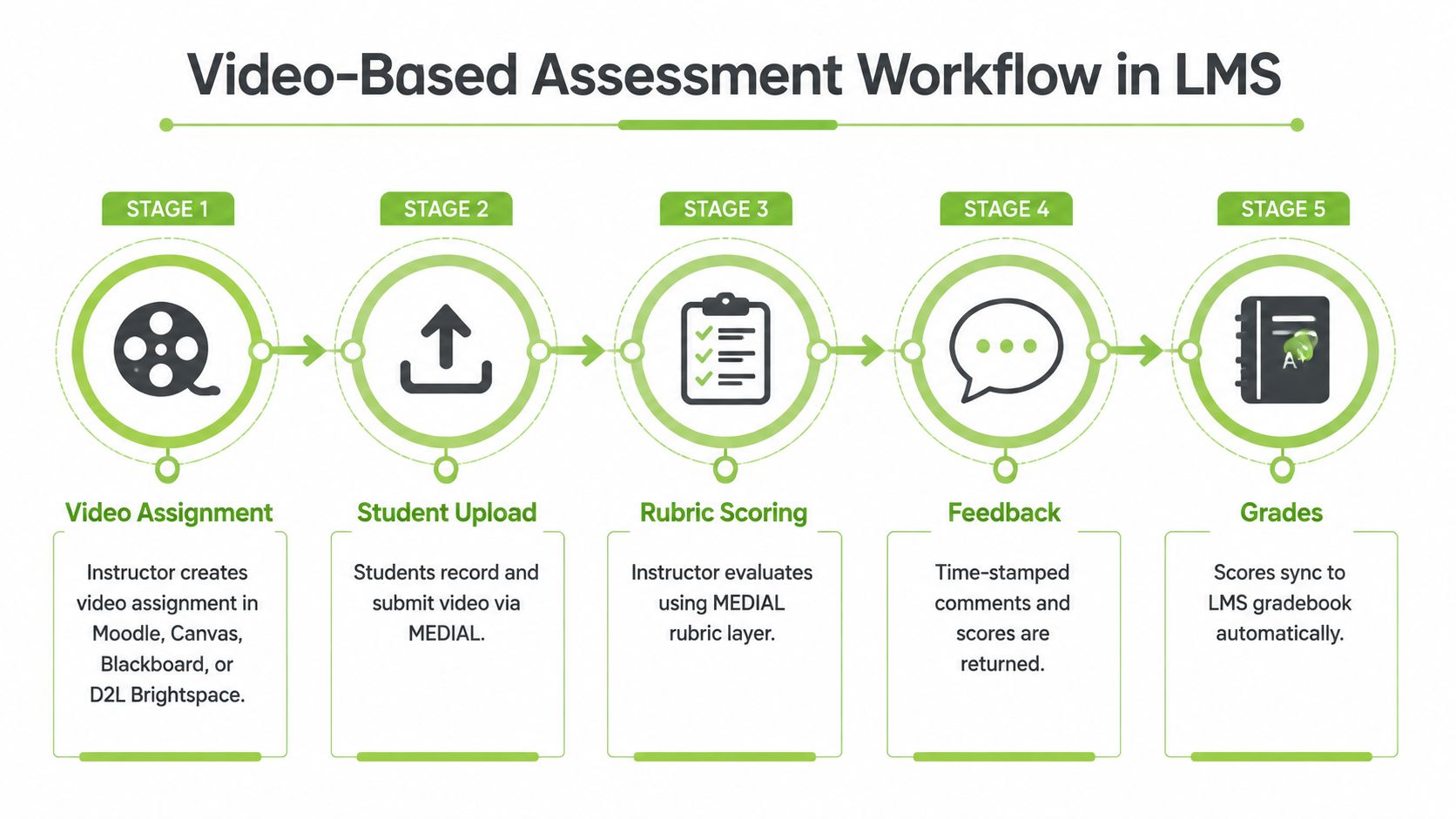
A video workflow should feel like part of the course, not a separate media project. With MEDIAL acting as the video and rubric layer, educators can connect activity inside Moodle, Canvas, Blackboard, or D2L Brightspace to submission, marking, feedback, and grade records.
Stage one, write the evidence into the brief
Start with the skill, not the camera. State what learners must demonstrate, what context they should use, the expected duration or scope, and which rubric criteria will be applied. A sales trainee might need to diagnose a customer problem and justify a recommendation. A student teacher might need to explain a lesson adaptation using evidence from learner responses.
Keep the brief specific enough to guide performance without scripting every word. Include acceptable formats, privacy expectations, captioning information, file or browser requirements, and the consequences of missing evidence.
Stage two, support recording and submission
Students record, edit, and upload through MEDIAL's browser-based studio. They can trim the recording, prepare the sequence, and submit through the activity embedded in the LMS. Automatic caption generation can support accessibility and give learners a text route back into their own performance, although educators should still explain how captions will be checked.
The LTI connection is the connective tissue. An administrator configures the tool link in the chosen LMS, establishes the relevant course and assignment context, and enables single sign-on so users don't need a separate account journey. The institution should test permissions, retention, accessibility, and the experience on common devices before the task opens.
Stage three, mark where the evidence occurs
Markers scrub through the timeline, apply rubric criteria, and leave timestamped comments or voice notes. Instead of writing a general paragraph at the end, they can identify the exact moment where the learner made a sound decision, skipped a safety step, or used weak evidence.
Feedback can then be released inside the LMS and the score passed back to the gradebook. The video feedback for students guidance is useful when planning how learners will receive, interpret, and act on those comments.
Stages four and five, moderate and redesign
Internal moderation should sample submissions across performance levels and relevant learner groups. Reviewers can compare rubric interpretations, flag drift, and trigger re-marking when disagreement exceeds the threshold established in the assessment policy. The purpose isn't to make every professional judgement identical. It's to identify when the task or rubric permits too much unexplained variation.
Finally, feed the evidence into the next design cycle. Review pass rates, turnaround metrics, criterion-level averages, common feedback themes, technical problems, and moderation outcomes. Plagiarism checks can sit alongside submission review where the institution's policy requires them. The Magenta Book guidance on evaluation states that planned, live, and completed government evaluations from 1 April 2024 onwards must be registered on the Government Evaluation Registry. For education and training teams, the broader lesson is practical: record the evaluation plan at the start, then update it as evidence accumulates.
The Government Analysis Function's evaluation support guidance identifies the Magenta Book as the core HMT guide and points to the Government Analytical Evaluation Framework for checking the knowledge and skills required at each evaluation stage. That workflow prevents evaluation from becoming an afterthought.
Common Pitfalls That Undermine Evaluation and Assessment Quality
More assessment doesn't automatically produce better learning. It can create more opportunities for practice, but it can also overwhelm learners, dilute feedback, and increase inconsistency between markers.
Some claims about assignment volume and inter-marker agreement cannot be treated as universal facts without a verifiable source and context. The safer conclusion is still clear: institutions should examine their own assessment load and marking reliability rather than assume that a busy assessment calendar represents rigour.
Four failures to look for
Designing the rubric after marking begins creates moving criteria. Markers start with one interpretation, discover unexpected responses, and adjust their standards informally. Write the rubric before submissions arrive, test it against sample work, and revise ambiguous descriptors before live marking.
Treating feedback as a broadcast leaves the learner with information but no planned response. A comment such as “be more critical” doesn't tell the learner what to do. Pair each comment with an action, such as comparing two interpretations, identifying an assumption, or re-recording a short explanation.
Ignoring cohort sampling for moderation allows disagreement to hide inside averages. Sample high, middle, and low performance, and check whether the task behaves differently for learners with different entry routes, language backgrounds, or access needs.
Confusing volume with rigour produces repeated low-value tasks. A short formative check may reveal more about a misconception than another graded essay, especially when the educator can respond before the final judgement.
The 2022 systematic review of 55 eligible studies on technology-supported formative assessment in UK schools found promising gains for maths and reading among younger children, but no good evidence of effectiveness for other subjects, older pupils, or superiority over non-digital formative assessment. It also found no good evidence that learner response systems improved attainment and judged much of the underlying research to be low quality, as reported in the review of technology-supported formative assessment.
That finding doesn't reject technology. It argues for subject-specific pilots and causal evaluation before scale-up.
Look beyond the headline average
In England's 2025 key stage 2 results, 62% of pupils met the expected standard in reading, writing and maths combined. Only 4% of disadvantaged pupils reached the higher standard, compared with 11% of other pupils, according to the revised key stage 2 attainment data.
An aggregate average can conceal material equity effects. Report outcomes by relevant disadvantage status and other appropriate learner characteristics, then ask whether the intervention changed progression, participation, or confidence as well as grades.
For a practical treatment of the concepts behind dependable decisions, assessment validity and reliability can help teams distinguish whether a task measures the intended outcome and whether the judgement remains consistent.
Your Evaluation and Assessment Rollout Checklist and Next Steps
A workable rollout starts with a small audit and expands only when the evidence supports it. Before launching a new video assessment, check the following:
Outcome alignment: Name the learning outcome and identify the evidence that would demonstrate it.
Rubric clarity: Test every descriptor against real examples and remove vague praise words.
Formative checkpoint: Give learners a chance to practise, receive guidance, and respond before the summative task.
Marker calibration: Mark shared examples, discuss disagreements, and record the agreed interpretation.
Submission rules: Explain recording, editing, captions, privacy, accessibility, and technical support.
Integration settings: Test LTI launch, single sign-on, grade pass-back, permissions, retention, and plagiarism checks.
Moderation plan: Define the sample, reviewers, escalation route, and re-marking threshold.
Evaluation measures: Decide which qualitative and quantitative evidence will show whether the assessment worked.
The sequence matters. Rubric and outcome decisions come before the workflow configuration. Calibration comes before live marking. Moderation and analytics come before claims about reliability or impact.
A practical 90-day sequence
Weeks one to four, pilot. Select a manageable cohort and one assessment moment. Run the formative activity, collect submissions, monitor technical issues, and ask learners whether the instructions and criteria were understandable. Don't scale a confusing task just because the platform functioned correctly.
Weeks five to eight, calibrate. Review sample submissions with markers, revise the rubric, clarify the brief, and test feedback language. Examine criterion-level patterns and moderation notes. If markers disagree because the task is ambiguous, fix the task rather than instructing markers to “be more consistent”.
Weeks nine to twelve, expand and review. Roll out to the wider programme when the workflow is stable. Review analytics, learner feedback, turnaround, criterion patterns, and moderation outcomes. Record what changed, what remained uncertain, and what the next cycle should test.
Three actions will get the work moving:
Choose one assessment and rewrite its criteria as observable evidence.
Create one formative video checkpoint before the final submission.
Run a small pilot in your existing LMS, then meet markers to review the evidence together.
The aim isn't to replace professional judgement with a dashboard. It's to give judgement better evidence, make feedback usable, and turn each assessment cycle into an improvement cycle.
MEDIAL provides video recording, editing, caption generation, rubric-linked feedback, and LMS-connected submission workflows for educators and training teams. Visit MEDIAL to explore how a video-based evaluation and assessment process could fit your Moodle, Canvas, Blackboard, or D2L Brightspace environment.
Comments